

Time management advice usually boils down to the same tired tips. Wake up earlier, make a to-do list, and stop checking your phone so much. Most people have heard all of it, and none of it sticks. The real problem is not knowing what to do. It is actually doing it.
The right books dig deeper than the surface-level hacks. They get into the psychology of why certain tasks never get done and how to structure a day around the work that actually matters. A few carefully chosen reads can change how an entire workday feels.
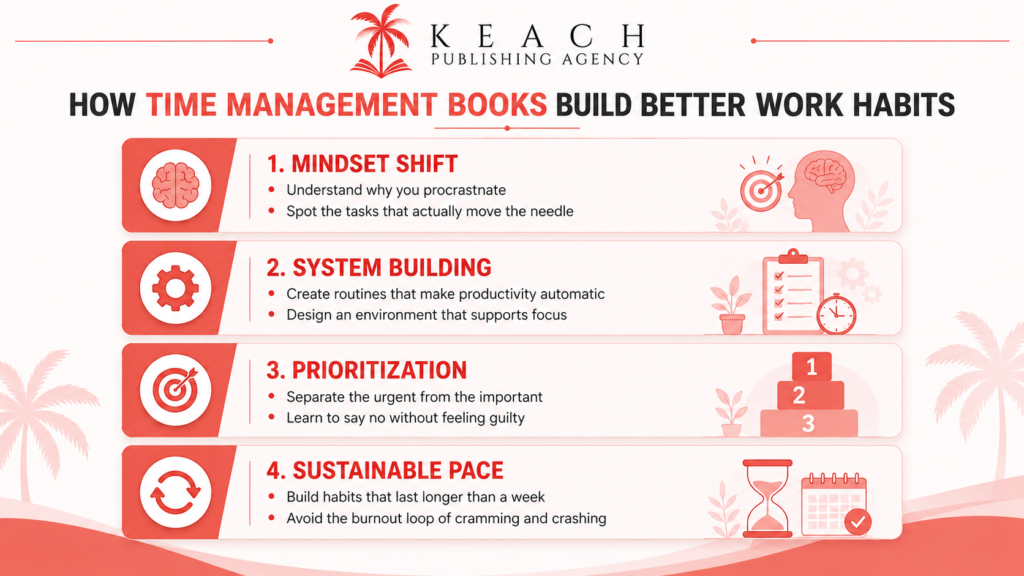
How Time Management Books Improve Habits
The Best Time Management Books for Professionals That Actually Change How You Work
The search for time management books for professionals slides right past a lot of recycled advice. Books that swear they can make anyone a productivity machine overnight and books that push systems that work for exactly one personality type. The ones worth reading get that different brains need different approaches.
“Deep Work” by Cal Newport is the standout here. Newport makes the case that the ability to focus without distraction is turning into a superpower in the modern economy. The book does not just explain why focus matters. It lays out a way to build a work life around it. The best time management books meet people where they actually are instead of where some guru thinks they should be.
For a broader look at related skills, this guide on communication books for leaders covers another essential professional skill.
Productivity and Time Management Books That Go Beyond the Surface
The best productivity and time management books get that getting things done is not just about willpower. “Atomic Habits” by James Clear barely mentions time management directly. Instead, it zeroes in on the tiny behaviors that stack up into massive results over time. The four laws of habit formation work for everything from exercise to email.
The book hits because it does not ask anyone to become a different person. It asks them to build systems that make good choices easier and bad choices harder. These best time management books shift the focus from motivation to the environment.
Keach Publishing curates productivity books that teach real strategies.
Find your next read and take back control!Books on Time Management That Change How You Prioritize
One of the key things that any good book on time management tries to convey is that sometimes, the art of saying “no” is equally important as being productive. “Essentialism” by Greg McKeown argues that most of us are overextended since we never learn how to filter out what is non-essential. Discipline of less is not about doing less stuff, but rather doing the right stuff.
“The One Thing” by Gary Keller presents the same idea, but through a different perspective. What is that one thing which would make everything else either easier or irrelevant? By answering such questions, one can change his/her to-do list completely overnight. The best time management books prevent people from confusing productivity with mere activity.
Best Productivity Books That Help You Work Smarter, Not Harder
The best time management books understand that energy management is just as important as time management. “The Power of Full Engagement,” by Jim Loehr and Tony Schwartz, contends that energy management is better than time management. Great performance results from alternating between high-intensity and actual rest periods.
“Getting Things Done,” by David Allen, is the definitive book about the process of collecting your tasks and organizing them so that they no longer clutter up your mind. It is a complex process, but the basic principle behind the method is straightforward. A clear mind, a system you can trust, and the ability to concentrate on what you’re doing.
For a look at related professional skills, this guide on negotiation books for business owners covers another essential competency.
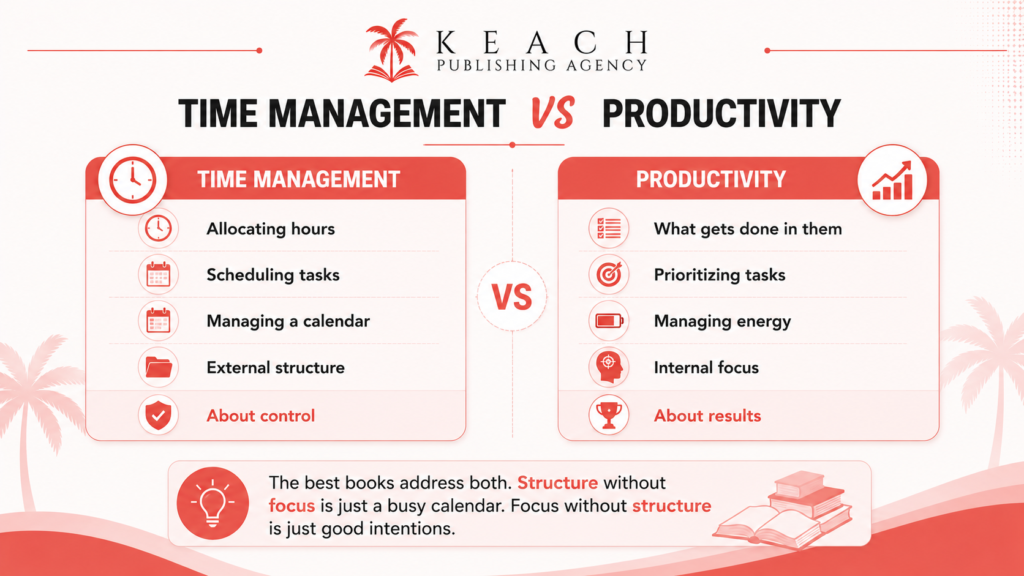
A Comparison of Time Management vs Productivity
Time Management Books for Entrepreneurs Who Juggle Everything
The best time management books for entrepreneurs understand that founders wear too many hats. “The E-Myth Revisited” by Michael Gerber is not strictly a time management book, but it solves the core problem that kills productivity. Working in the business instead of on it.
Building systems and processes frees up time for the work that actually grows the company. These best time management books help entrepreneurs step back from the daily grind long enough to fix the grind itself.
A Few Pages That Change the Whole Day
It is not the time management books that are simply read and put away. Rather, it is the ones that quietly transform the way one approaches his/her mornings, meetings, and even Mondays as he/she begins to lose concentration. These frameworks are adopted until they no longer feel like techniques but become instinctive.
This is what we strive to deliver through our collection. It is the kind of gradual transformation that comes about through time management books that have really helped professionals reclaim hours and dedicate them to something worthwhile. The appropriate time management book read at the right time will not only make one productive but will also ease work.
Find more curated picks and resources for professionals.
Visit Keach Publishing and find something worth your time.