
One time, there was a writer who was writing his first book and presented a manuscript to an editor, requesting a proofread. However, when the editor looked at the manuscript and saw the first chapter, he explained to the writer that first the book had to undergo development before worrying about the commas.
Editing is not one thing. It is a series of passes that examine a manuscript from different angles. Understanding what each type of editing actually does prevents the mistake of hiring the wrong kind of editor for the stage a manuscript is actually in.
The Different Types of Book Editing and What Each One Actually Does
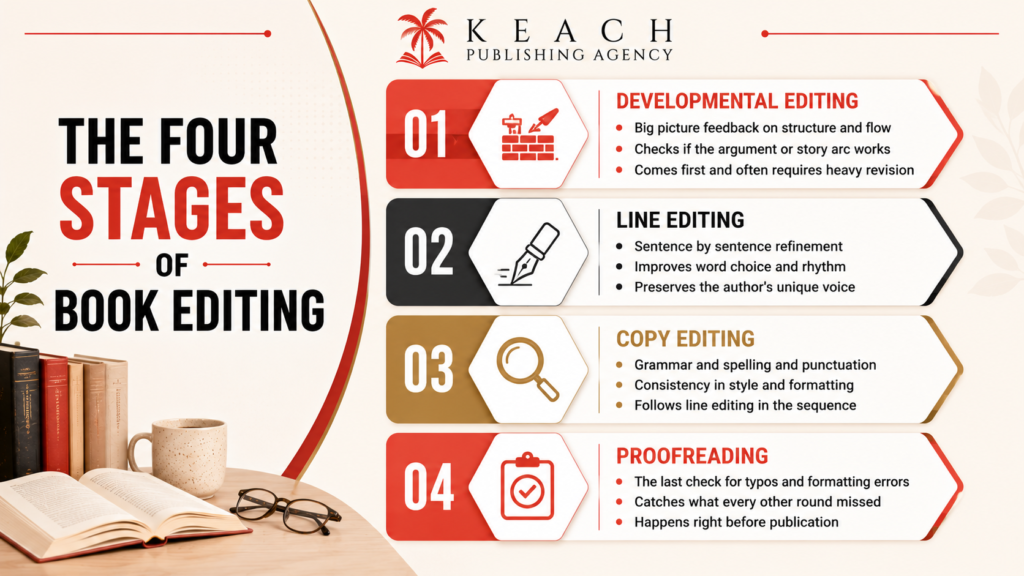
The types of book editing follow a logical sequence. Developmental editing comes first and examines the big picture. The structure of the argument or the narrative arc and whether the chapters flow in a logical order. This is the most intensive type of editing and often requires significant revisions from the author.
Line editing comes next and works at the sentence level. Tightening prose improves word choice and makes sure the author’s voice comes through clearly. Then copyediting catches grammar, spelling, and consistency errors. Proofreading is the final pass for typos and formatting mistakes. Each stage of book editing catches problems the previous stage missed.
For a look at why professional help matters, this guide on professional book editing services covers the value editors bring.
Four Stages of Book Editing
Developmental Editing and Why It Comes First
The process of developmental editing is about making sure the book works as a whole. Fiction editors look at plot and character development and pacing. Nonfiction editors examine the strength of the argument and whether the chapters build on each other logically.
Skipping developmental editing is the most common mistake first-time authors make. A book with beautiful sentences that does not hold together structurally will still lose readers. Good types of book editing follow the right order.
Keach Publishing connects authors with editors who know which stage comes first.
Start the Conversation.Line Editing and What Happens at the Sentence Level
The work of line editing is where the prose gets tightened and polished. An editor looks at word choice and sentence rhythm and whether each paragraph leads naturally into the next. This is not about fixing typos. It is about making the writing more effective at doing what the author intended.
A manuscript editing process that includes strong line editing transforms competent writing into compelling writing. The author’s voice stays intact, but the clarity improves on every page.
For a look at what this costs, this guide on book editing pricing covers the investment at each stage.
&
Understand what editing involves from start to finish, this guide on what book editing is covers the full process.
Copy Editing and the Final Polish Before Proofreading
The role of copy editing is catching everything that slipped through the earlier rounds. Grammar mistakes and spelling errors and inconsistencies in names or dates or formatting. A character whose eye color changes halfway through a novel. A business book that uses different terms for the same concept.
Professional types of book editing treat copy editing as a separate step from proofreading. Each pass catches different types of errors. Rushing through both at once guarantees things get missed.
An Edited Book Is a Respected Book
Readers can tell when a book has been professionally edited. The experience feels smooth and effortless. They can tell when it has not been edited too. The rough edges distract from the message and the story. Editing is not an expense. It is the investment that makes everything else work.
We connect authors with editing services that strengthen every aspect of a manuscript. Structure and flow and grammar and voice all get the attention they deserve. The book that goes to print is the best version of itself.
Let Keach Publishing connect you with professional editing at every stage.
Take the next step with confidence.