
You have a book on Amazon. Maybe it is selling well. But something nags at you. What about all the readers who do not shop on Amazon? What about Apple Books users? Kobo readers? People who buy from Barnes & Noble? You are right to wonder.
Putting all your eggs in one basket is risky. Amazon is the giant, no question. But millions of readers prefer other stores. And there is something freeing about not being tied to one retailer’s rules. The good news is that publishing everywhere is easier than you think. You just need a plan. Let me walk you through how to publish a book on multiple platforms without losing your mind.
Keach Keach Publishing helps authors publish book everywhere with a smart multi-platform strategy.
Let us help you expand your reach without expanding your stress.Why Should You Publish on Multiple Platforms?
Amazon dominates the ebook market. But domination is not total. Millions of readers buy from Apple Books, Kobo, Google Play, and Barnes & Noble. Some prefer these platforms for their device ecosystem. Others want to avoid giving all their money to one company. There is another reason to go wide. Control.
When you publish only on Amazon, you play by their rules. If your account gets suspended, your income stops. If Amazon changes its royalty structure, you have no alternative. When you distribute across multiple platforms, you diversify your risk. One platform changing its policies hurts less.
The trade-off is complexity. Managing multiple accounts, tracking different royalty reports, and formatting for various platforms takes work. But for serious authors, the benefits outweigh the hassle.
How to Publish Book Everywhere Without Overwhelm
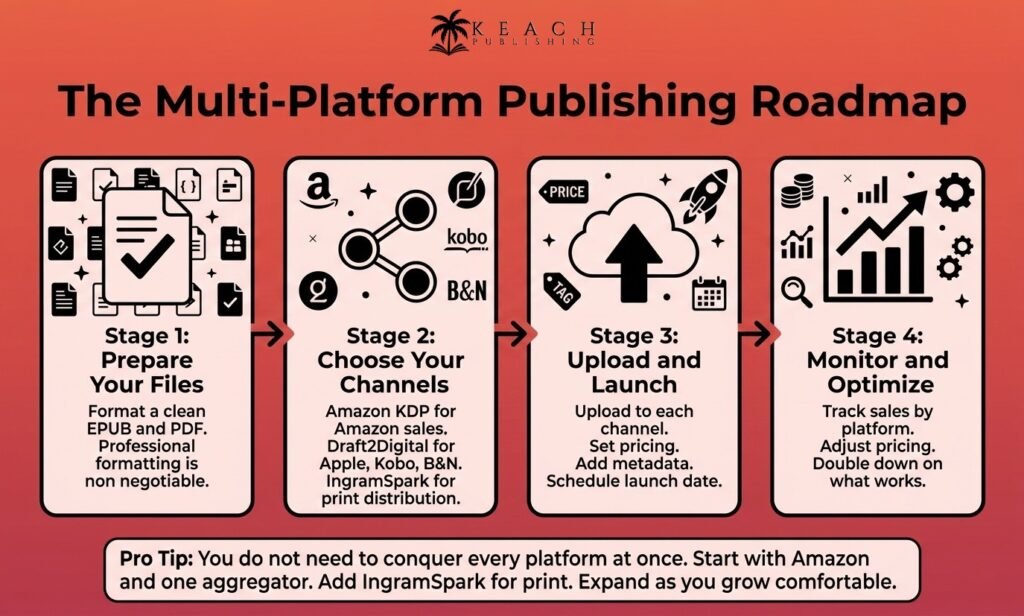
The phrase publish book everywhere sounds exhausting. But you do not need to upload your book to ten different websites one by one. There is a better way.
Aggregators are services that distribute your ebook to multiple retailers simultaneously. You upload once. They handle the rest. Your book appears on Apple Books, Kobo, Barnes & Noble, and other platforms within days.
Draft2Digital is the most author-friendly option. Their interface is simple. Their customer service is excellent. They take a small percentage of your royalties, but the time savings are enormous.
Smashwords is another popular choice. They distribute to many of the same retailers, plus a few extras. Their formatting requirements are stricter, but their reach is broad.
PublishDrive is a more advanced option with powerful analytics and pricing tools. It works well for authors with large catalogs. The key is picking one aggregator and sticking with it. Do not try to manage direct accounts with every retailer on day one. Start simple. Expand later.
Which Book Distribution Platforms Should You Target?
Amazon KDP is the 800-pound gorilla. Even when going wide, most authors keep their books on Amazon. The platform is simply too big to ignore. You can publish directly through KDP while using an aggregator for other stores. This is standard practice.
Apple Books is the second-largest ebook retailer. Apple users tend to spend more per book than Amazon customers. The platform is particularly strong for romance, literary fiction, and children’s books.
Kobo is a quiet powerhouse. They have a loyal user base, especially outside the United States. Kobo Plus, their subscription service, creates additional earning potential for enrolled titles.
Barnes & Noble Press reaches Nook users and is the largest bookstore chain in America. Physical bookstore placement is possible if your book performs well.
Google Play Books is often overlooked but has a global reach, particularly on Android devices. Their search algorithms can surface your book in unexpected ways.
Book Distribution Platforms at a Glance
| Platform | Best For | Distribution Method |
|---|---|---|
| Amazon KDP | Maximum reach in the US and the UK | Direct upload |
| Apple Books | Higher price points | Aggregator recommended |
| Kobo | International readers | Direct or aggregator |
| Barnes & Noble Press | US Nook users | Direct or aggregator |
| Google Play Books | Android users globally | Aggregator recommended |
What Does Global Book Distribution Actually Mean?
Global book distribution sounds fancy. But what does it actually mean for you as an author? It means your book is available in multiple countries, through multiple retailers, in multiple formats. A reader in Australia can buy from Kobo. A reader in Canada can buy from Apple Books. A reader in the UK can buy from Google Play.
This matters more than you might think. Amazon does not have the same dominance in every country. Kobo is strong in Canada. Apple Books has a significant market share in Australia and the UK. By distributing globally, you capture sales you would otherwise miss.
Aggregators like Draft2Digital handle international pricing and currency conversion automatically. You set your base price in your home currency. The aggregator calculates prices for other markets. Royalties are paid in your currency.
One note of caution. International sales are wonderful, but they come with complexity. Tax treaties, currency fluctuations, and different consumer protection laws all factor in. A good aggregator handles these details for you. Trying to manage them yourself is not recommended.
How to Publish Book Worldwide Without Losing Your Mind
The goal to publish book worldwide is admirable. Here is a sane approach that will not burn you out. Start with Amazon only for your first book. Learn the basics. Get comfortable with the process. For your second book, expand. Set up a Draft2Digital account. Upload your ebook files. Select which retailers you want to target. Start with Apple Books and Kobo. Add more as you get comfortable.
Keep your paperback distribution simple. Amazon KDP handles paperback sales on Amazon. For bookstores and libraries, IngramSpark is the standard. You can use both. They serve different purposes. Track everything in a spreadsheet. Which platforms earn what? Which months are strongest? Which retailers are worth your time? Use data to decide where to focus.
Understand that global distribution takes time. Your book will not appear everywhere overnight. Retailers have different review processes. Some take days. Some take weeks. Patience is part of the game. If you have been following our series, you know that advanced authors think beyond single platforms.
Our previous post on Advanced Self-Publishing Strategies for Serious Authors covers the systems and data tracking that make multi-platform publishing sustainable. The two strategies work hand in hand.
Keach Publishing offers book distribution guidance that simplifies the complex.
We help you go wide without the headache.What Format Do You Need for Multi-Platform Publishing?
EPUB is the universal standard for ebooks. Every retailer except Amazon accepts EPUB files. Some have specific requirements, but a clean, well-formatted EPUB works almost everywhere.
Amazon uses MOBI or KPF for Kindle books. KDP will convert your EPUB or DOCX file automatically. Many authors upload a DOCX directly. The conversion is usually fine.
PDF is for print books only. Never upload a PDF as an ebook. The reading experience will be terrible on small screens.
Most aggregators accept DOCX or EPUB and handle the conversion for each retailer. This is one reason they are so valuable. You do not need to master five different formatting specifications.
Professional formatting is worth the investment. A poorly formatted book looks amateur. Readers notice. They leave reviews about weird spacing and broken chapter headings. Pay a professional once. Use that file everywhere.
What Rights Do You Need for Global Distribution?
This is where many authors get confused. Rights management matters. For most self-published authors, you own all rights to your work. You can publish anywhere, anytime. No permission needed.
However, if you use KDP Select, you grant Amazon exclusivity for your ebook. You cannot distribute that ebook anywhere else during the 90-day enrollment period. Paperbacks are never exclusive to Amazon. You can sell paperbacks anywhere, regardless of KDP Select status.
When you publish through an aggregator like Draft2Digital, you retain all rights. You are simply permitting them to distribute your book on your behalf. You can cancel anytime.
Aggregators take a percentage of your royalties. Typically, 10 to 15 percent. This is the cost of convenience. Many authors find this trade-off worthwhile. Read your contracts. Understand what you are agreeing to. Most author agreements are straightforward. But never sign anything you have not read.
Keach Publishing provides professional self-publishing guidance for authors ready to expand.
Let us help you reach readers everywhere.Wrap Up
Publishing on multiple platforms is not an all-or-nothing decision. You can start with Amazon, add one new retailer at a time, and expand as you grow comfortable. The key is having a plan and using the right tools.
Aggregators like Draft2Digital make the process manageable. Professional formatting ensures your book looks good everywhere. And a clear rights strategy keeps you out of legal trouble.
At Keach Publishing, we help authors navigate every stage of multi-platform publishing. From professional formatting to distribution strategy to author websites, we handle the technical complexities so you can focus on writing. Your book deserves to find readers wherever they shop. Let us help you make that happen.