

You know the feeling. You open Instagram, TikTok, or Facebook. You see other authors posting constantly. They have thousands of followers. Their books seem to be everywhere. You feel a familiar knot in your stomach. Am I supposed to be doing that? Why is no one engaging with my posts? What am I doing wrong?
Here is what most social media gurus will not tell you. That author with thousands of followers? They probably feel just as overwhelmed as you do. Those perfectly curated posts? They took hours to create. The engagement you are chasing? It often does not translate to book sales the way you hope.
social media marketing for authors can be a valuable tool. But only if you approach it strategically. Only if you protect your time and energy. Only if you remember that you are a writer first and a content creator second.
Let me walk you through a sane, sustainable approach to social media that actually supports your author career.
Keach Publishing helps authors focus on what matters most: writing and connecting with readers.
Let us help you build a social media approach that fits your goals.Why Most Authors Get Social Media Wrong
The biggest mistake I see authors make is trying to be everywhere at once. Instagram, TikTok, Facebook, Twitter, LinkedIn, Threads, Pinterest. They spread themselves so thin that nothing they post gains any traction. Then they burn out and quit altogether.
Social media success does not come from being everywhere. It comes from being somewhere consistently.
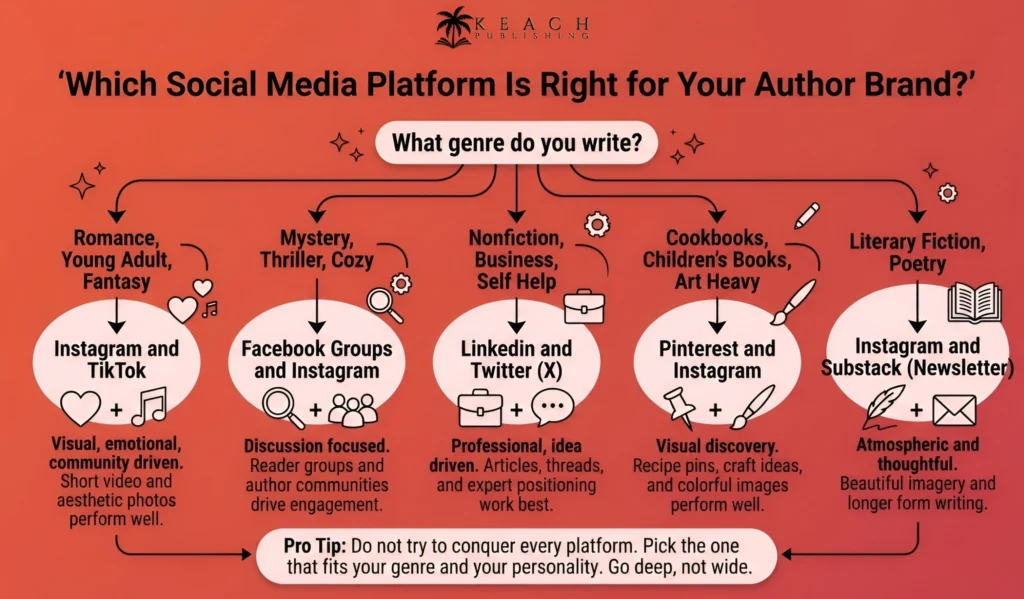
Pick one platform. Just one. The one where your readers actually spend time. For romance and young adult authors, Instagram and TikTok work well. For business and nonfiction authors, LinkedIn is worth a look. For mystery and thriller writers, Facebook groups can be gold. For visual genres like cookbooks or children’s books, Pinterest shines.
Once you pick your platform, commit to it for six months. Learn its quirks. Understand what kind of content performs well. Build a genuine presence. Then, and only then, consider adding a second platform.
Building Your Author Brand Without Losing Yourself
Author branding sounds corporate and uncomfortable. But it is simpler than you think. Your brand is just the consistent feeling readers get when they encounter you.
Ask yourself three questions. What do I write? What do I care about? How do I want readers to feel when they see my posts?
If you write cozy mysteries, your brand might feel warm, witty, and slightly mischievous. If you write dark thrillers, your brand might feel intense and atmospheric. If you write hopeful romance, your brand might feel uplifting and warm.
Your brand shows up in your voice, your visuals, and the topics you choose to discuss. It does not need to be complicated. Just consistent. A reader should be able to see three of your posts without seeing your name and know they were all written by the same person.
Do not try to be someone you are not. Readers can spot inauthenticity from a mile away. Post about what genuinely interests you. Share your real opinions. Let your personality show. The right readers will find you.
How To Promote Book On Social Media Without Feeling Gross
The phrase promote book on social media often conjures images of desperate posts. “Buy my book!” “Link in bio!” “Only 99 cents!” Posted over and over again. That approach does not work. It annoys your followers and makes you feel like a used car salesman.
The 80/20 rule is your friend. Eighty percent of your posts should provide value. Entertainment, education, inspiration, behind the scenes glimpses. Twenty percent can be direct promotion. Ask for the sale. Share your buy links.
Here is what value looks like in practice. A behind-the-scenes look at your writing space. A funny observation about a character who refuses to behave. A recommended read from another author in your genre. A short video answering a question readers often ask. A photo of your research trip or your messy first draft.
These posts build a connection. They make readers feel like they know you. And when you do ask for the sale, those same readers are far more likely to buy because they feel invested in your success.
Direct promotional posts work best when they feel like celebrations rather than pleas. “My book is finally out in the world, and I am so excited to share it with you” lands very differently than “Please buy my book.” One invites. The other begs.
If you want a deeper look at other ways to get discovered, our previous post on Using SEO to Promote Your Book Online covers organic search strategies that work alongside your social media efforts. Together, they create a complete discoverability engine.
Keach Publishing offers guidance on social media marketing for authors without the overwhelm.
We help you find a sustainable rhythm that actually fits your life.Book Promotion Strategies That Actually Work On Social Media
Let us talk about specific book promotion strategies for social media. These are tactics that real authors use to move copies without burning out.
Run a targeted giveaway. Ask followers to tag a friend who would love your book. The winner gets a signed copy. Giveaways increase your reach and build your email list if you require a signup. Keep the entry requirements simple. Too many steps, and people will drop off.
Share reader reactions. When someone posts a photo of your book or leaves a glowing review, share it. Tag them. Thank them. This builds community and provides social proof. Potential buyers see that real people are enjoying your work.
Go live occasionally. Live videos feel raw and authentic. Answer questions. Read a short passage. Show your writing space. The algorithm often favors live content, and the unpolished nature builds a connection.
Collaborate with other authors. Do an Instagram Live together. Cross-post each other’s content. Share each other’s books. You reach new audiences without starting from zero. Find authors at a similar career stage and propose a simple collaboration.
Use hashtags strategically. On Instagram, use 5 to 10 relevant hashtags. Mix popular ones like #amwriting with niche ones like #cozymysteryauthor. On TikTok, focus on trending sounds and hooks rather than hashtags.
Sample Social Media Content Mix
| Content Type | Example | How Often |
|---|---|---|
| Behind the Scenes | Photo of your messy desk or coffee cup | 2 to 3 times per week |
| Reader Engagement | Ask a question about reading habits | 1 to 2 times per week |
| Book Promotion | Cover reveal, sale announcement, new release | Once per week |
| Recommendation | Share another author’s book you love | Once per week |
| Personal | Something unrelated to writing that you enjoy | Once per week |
Protecting Your Time And Mental Energy
Social media is designed to be addictive. The infinite scroll. The notification badges. The constant comparison. If you are not careful, you can lose hours of writing time without even realizing it.
Set boundaries. Decide how much time you will spend on social media each day. Thirty minutes. One hour. Whatever feels right. Use a timer. When it goes off, close the apps and walk away.
Schedule your posts. Use tools like Later, Buffer, or Meta Business Suite to batch create content and schedule it in advance. Spend two hours on Sunday planning your week. Then do not think about social media again until next Sunday.
Turn off notifications. You do not need to know the moment someone likes your post. Check your accounts on your own schedule. Notifications are designed to pull you back in. Resist.
Remember why you started this journey. You are a writer. Your primary job is to write the next book. Social media is a tool, not the goal. Do not let it steal the creative energy that belongs to your manuscript.
Keach Publishing helps authors build sustainable social media habits that support their careers.
Let us help you turn social media into a genuine asset.Final Thought
Social media can be a wonderful tool for authors. It can help you find your people, build a community, and sell books. But only if you approach it with intention. Pick one platform. Show up consistently. Share value before you ask for the sale. Protect your time and mental energy.
The authors who succeed on social media are not the ones with the most followers. They are the ones who stay true to themselves. They are the ones who remember that they are writers first. They use social media as a tool, not a tyrant.
At Keach Publishing, we help authors navigate every aspect of building their careers. From professional author websites to platform setup to marketing guidance, we handle the technical complexities so you can focus on what you do best. Writing and connecting with readers.
Your book deserves to be read. And your voice deserves to be heard. Social media can help with both, as long as you use it wisely.