
You published your book. The cover looks great. The writing is solid. You hit that publish button with a sense of accomplishment. Then the days pass. Then weeks. Sales trickle in slowly, if they come at all. What went wrong?
Here is the thing most new authors never realize. Publishing a book on Amazon is only half the battle. The other half is making sure readers can actually find it. Amazon is a search engine first and a bookstore second. If your listing is not optimized, your book might as well be invisible.
The good news is that optimization is not magic. It is a set of clear, actionable steps that any author can take. You do not need a technical background or a marketing degree. You just need to understand how Amazon thinks and what readers are searching for. Let me walk you through exactly how to fix that listing and start getting your book in front of the right eyes.
Keach Publishing helps authors optimize their listings for maximum visibility.
Let us handle the technical SEO so your book gets found.Understanding Amazon Book SEO
Search engine optimization sounds complicated. On Google, it involves backlinks, page speed, and a hundred other factors. But amazon book seo is simpler. Amazon wants one thing. To show shoppers the book most likely to lead to a purchase.
The platform ranks books based on relevance and performance. Relevance means how well your listing matches what a shopper typed into the search bar. Performance means how many sales and page reads your book generates. The two work together. A relevant listing gets seen. A seen listing that sells well rises higher. Higher rankings lead to more visibility. You can see how this cycle builds on itself.
Your job is to make sure your listing signals relevance clearly. Every element matters. The title. The subtitle. The keywords. The categories. The book description. Each one tells Amazon what your book is about and who should see it.
The Anatomy of a Winning Book Title
Your title is the single most important piece of real estate on your listing. It carries the most weight in Amazon’s search algorithm. Yet many authors waste this opportunity.
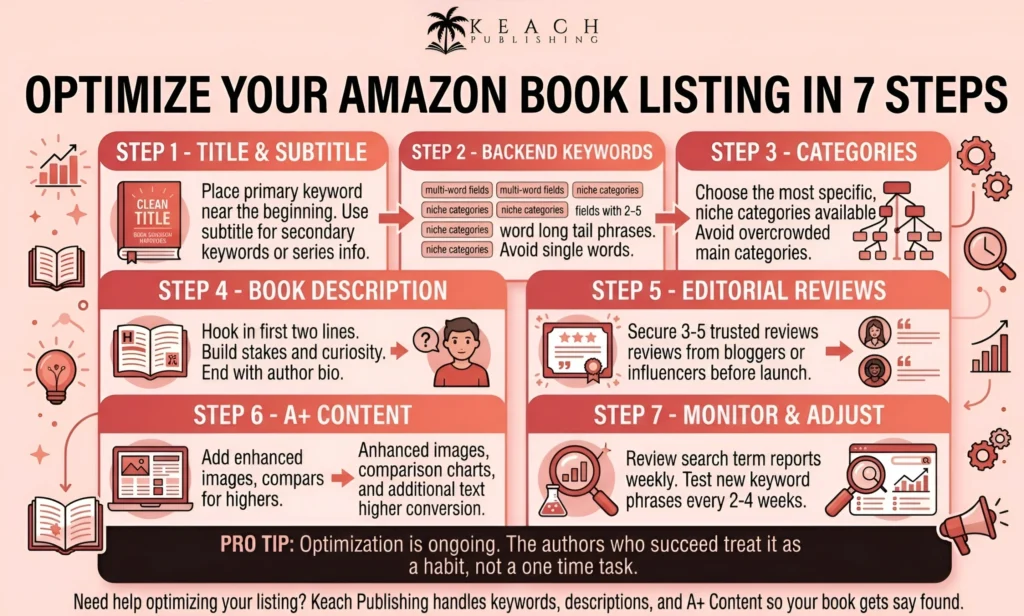
A strong title for optimization purposes includes your main keyword phrase near the beginning. If you wrote a cozy mystery about a baker who solves crimes, your title should include cozy mystery. Not at the end. Up front. For example, “The Deadly Cupcake: A Small Town Cozy Mystery” is better than “The Deadly Cupcake” alone.
But do not stuff keywords awkwardly. Readers notice when a title feels unnatural. The goal is a title that works for both humans and algorithms. It should grab attention, set expectations, and include your primary search term. That balance takes thought, but it pays off.
Your subtitle offers another opportunity. Use it to add context, hint at the premise, or include secondary keywords. Just keep both title and subtitle readable. If it looks like spam, shoppers will scroll past. Key Elements of an Optimized Amazon Book Listing
| Element | Why It Matters | Optimization Tip |
|---|---|---|
| Title | Highest SEO weight | Include the main keyword near the beginning |
| Subtitle | Secondary keyword placement | Add context or series information |
| Description | Converts browsers to buyers | Use hook, stakes, urgency structure |
| Backend Keywords | Powers search discovery | Fill all seven slots with long-tail phrases |
| Categories | Determines the competitive landscape | Choose specific, niche categories |
| Editorial Reviews | Builds social proof | Include at least 3 to 5 early reviews |
Mastering KDP Keywords for Discoverability
Here is where most authors stumble. When you upload your book, you will see seven blank fields labeled keywords. Many authors type a few single words like mystery, romance, or thriller and call it done. That is a missed opportunity.
The best kdp keywords are phrases. Two to five words long. Specific enough to attract serious buyers. Think about what a reader would type into Amazon’s search bar if they wanted a book exactly like yours. Not fiction. Small town mystery series. Not romance. Second-chance romance beach read.
Amazon allows up to 50 characters per keyword field. Use every single character. Combine related concepts. Test different combinations. You can change your keywords whenever you want, so treat this as an ongoing experiment. Run a phrase for two weeks, check your search term report, and adjust based on what actually drives traffic.
One practical approach is to study the auto-suggest feature. Start typing a phrase related to your book into Amazon’s search bar. See what completions appear. Those are real searches from real readers. Use them. Another method is to look at competitor books. Scroll to the bottom of their listing and see what categories and keywords they might be targeting.
If you want a deeper look at what not to do, our previous post on Common Mistakes New Authors Make on Amazon Publishing covers the errors that hurt discoverability. Avoiding those pitfalls is half the battle.
Keach Publishing handles backend optimization, so your book ranks for the right searches.
We help readers find your book without the guesswork.How to Improve Your Amazon Book Ranking
Amazon’s book ranking is driven primarily by sales velocity. How many copies do you sell in a short period? The algorithm favors books that gain momentum quickly. A book that sells 50 copies in its first week will rank higher than a book that sells 50 copies over two months, even though the total is the same.
This is why launch strategy matters so much. You want to concentrate your sales into a tight window. Build an email list before you publish. Gather advance reviews from ARC readers. Schedule promotions for your launch week. Run ads if your budget allows. Every sale in those early days boosts your ranking, which leads to more organic visibility.
Ranking also considers relevance. If your book consistently ranks for certain search terms, Amazon rewards that alignment. A book that sells well when shoppers search for “cozy mystery series” will eventually rank higher for that specific phrase. This creates a virtuous cycle. Good keywords lead to relevant traffic. Relevant traffic that converts leads to a better ranking. Better ranking leads to more traffic.
Crafting a Description That Converts
Search engines bring people to your listing. Your description turns them into buyers. Treat it with the same care you gave your manuscript.
The first line matters most. On Amazon, only the first two or three lines appear before a shopper must click “Read more.” That preview needs to hook immediately. Start with a question, a bold statement, or a compelling story setup. Give readers a reason to click that button.
After the hook, build tension. Introduce your protagonist and their problem. Hint at the stakes. Create curiosity without revealing the ending. Then close with a short author bio that builds trust. Keep paragraphs short. Use line breaks for white space. Think of your description as a sales page, not a book report.
Advanced Tips for Better Visibility
Once you have the basics covered, a few advanced tactics can push your listing further. Editorial reviews matter more than customer reviews for SEO. Amazon treats reviews from trusted sources differently. Reach out to bloggers, influencers, or established authors in your genre. Offer free copies in exchange for an honest review posted to your listing. Three to five strong editorial reviews signal quality to both Amazon and shoppers.
Also pay attention to your “Also Boughts.” These are the books Amazon displays alongside yours. They influence how the algorithm categorizes your work. If your cozy mystery keeps showing up next to romance novels, Amazon might start showing it to romance readers. That could be good or bad, depending on your genre. Monitor these connections and adjust your keywords if the associations feel off.
Finally, use A+ Content if you are enrolled in KDP Select. This feature lets you add enhanced images, comparison charts, and additional text to your listing. Books with A+ Content consistently convert better than those without. It takes time to create, but the return on investment is real.
Making Optimization a Habit
Optimizing your Amazon book listing is not a one-time task. It is an ongoing practice. The marketplace changes. Reader behavior shifts. New competitors enter your genre every day. The authors who succeed are the ones who pay attention and adjust.
Start with the fundamentals. A strong title. Well-researched keywords. Specific categories. A description that hooks and sells. Then layer in the advanced tactics. Editorial reviews. A+ Content. Monitoring your also boughts. Testing new keyword phrases.
The difference between a book that sells steadily and one that collects dust is often just a few small optimizations. A better title here. A smarter keyword there. These changes do not require a marketing degree. They require attention and intention.
At Keach Publishing, we help authors navigate exactly this process. From listing optimization to platform setup to author websites, we handle the technical side so you can focus on what you do best. Writing the next book. Your book deserves to be found. With the right optimization, it will be.
Keach Publishing offers complete listing optimization, including keywords, descriptions, and A+ Content.
Let us help you turn browsers into buyers.