

You have a book on Amazon. Maybe you even have a few reviews and a small trickle of sales. But something feels missing. Your book exists out there in the world, but you do not really have a home for it. A place where readers can learn about you, sign up for your newsletter, and buy your book directly. That place is a website for authors.
I hear authors say the same thing over and over. Do I really need a website? Social media feels easier. I can just post on Instagram or TikTok. Here is the problem with that thinking. You do not own your social media followers. The platform does. If Instagram changes its algorithm or TikTok disappears tomorrow, your audience goes with it.
Your website is different. You own it. You control it. It is your piece of digital real estate that no algorithm can take away. Every serious author needs one. Not a fancy, expensive one. Just a clean, functional home base that serves your readers and your career.
Let me walk you through exactly what you need.
Keach Publishing helps authors build professional websites that actually promote their books.
Let us handle the technical side.Why Every Author Needs A Website
An author’s website serves three critical purposes. First, it gives readers a central place to learn about you. Second, it captures email addresses so you can communicate directly with your audience. Third, it allows you to sell books directly without Amazon taking a cut of every sale.
Think of your website as your home base. Social media posts are like going to a party and telling people about your book. Your website is your front door. It is where people go when they want to know more, sign up for your newsletter, or buy a signed copy.
Readers expect authors to have websites. When someone enjoys your book, one of the first things they do is search for your name. If nothing comes up, or if they find an outdated blog from 2015, it creates a bad impression. A professional website signals that you are serious about your career.
Your website also helps with discoverability. Search engines index your site. When someone searches for your name or your book title, your website can appear right at the top. That is free traffic that you control.
What To Include On Your Author Website
A book marketing website does not need to be complicated. In fact, simpler websites often perform better. Here are the essential pages every author should have.
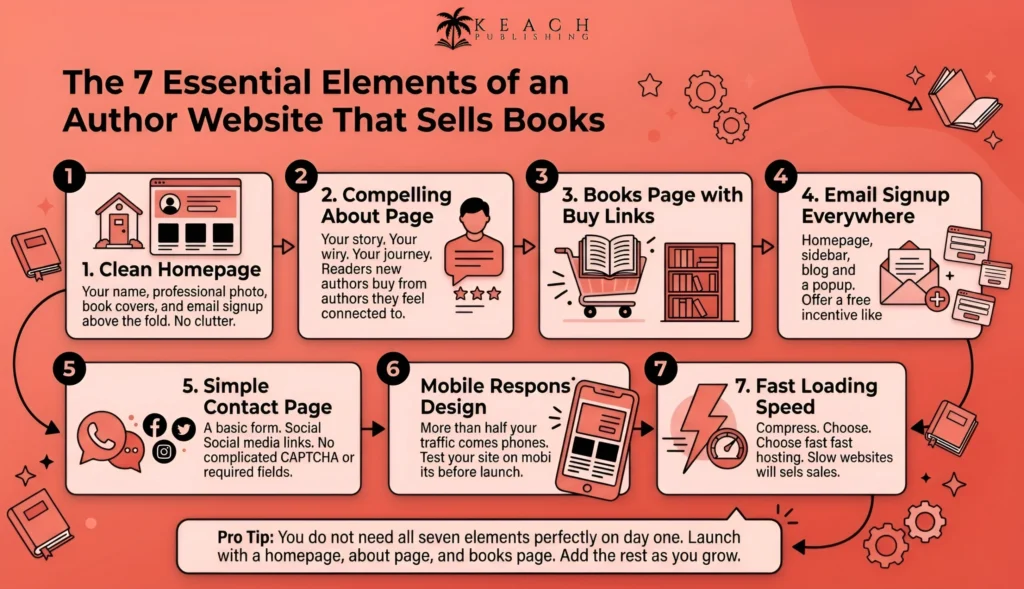
Your homepage should answer three questions immediately. Who are you? What do you write? Where can I buy your book? Use a clean header with your name and a professional photo. Include clear buttons linking to your books. Keep the design uncluttered.
Your about page is where readers go to connect with you personally. Share your story. Why do you write? What influences your work? Include a professional author photo. Readers want to feel a human connection. Give them something real.
Your books page should list every title you have published. Include covers, descriptions, buy links, and reviews. If you have multiple books, consider organizing them by series. Make it easy for readers to find what comes next.
Your contact page needs a simple form where readers can reach out. Also include links to your social media profiles and your email newsletter signup. Make it easy for people to stay in touch.
Your email signup form belongs everywhere. On your homepage. On your sidebar. At the end of every blog post. Offer a free incentive. A short story. A sample chapter. A printable bookmark. Something valuable enough that readers will trade their email address for it.
Author Website Design: Simple Wins
An author’s website design does not need to be flashy. In fact, the best author websites are clean, fast, and easy to navigate. Readers come for your books, not your animations.
Choose a simple, mobile-responsive theme. More than half of your traffic will come from phones. If your site is hard to read on a small screen, people will leave immediately. Test your site on your own phone before you launch.
Use high-quality images. Your author photo should be professional. Your book covers should be clear and readable. Avoid stock photos that look fake. Readers can tell.
Keep your fonts readable. Stick to one or two fonts maximum. Use enough contrast between text and background. Black text on a white background is classic for a reason.
Make your navigation obvious. Readers should never have to hunt for your books page or your email signup. Use clear labels. Books. About. Contact. Nothing clever or mysterious.
Speed matters. A slow website kills sales. Compress your images before uploading. Choose a fast hosting provider. Remove any plugins or widgets you do not actually need.
Author Website Design: Key Elements At A Glance
| Element | Purpose | Best Practice |
|---|---|---|
| Homepage | First impression | Your name, photo, book links, and email signup |
| About Page | Personal connection | Your story, your why, professional photo |
| Books Page | Showcase your work | Covers, descriptions, buy links, reviews |
| Contact Page | Reader outreach | Simple form, social links, email signup |
| Email Signup | Build your list | Offer free incentives, place them everywhere |
How To Use Your Website To Sell More Books
A website for authors is not just a digital business card. It is a sales tool. Here is how to use it effectively.
Capture email addresses aggressively. Your email list is your most valuable asset. Offer a free short story or sample chapter in exchange for an email address. Send a welcome email immediately. Then send regular newsletters with behind-the-scenes content, book recommendations, and occasional promotions.
Sell direct if you can. Platforms like Shopify or WooCommerce let you sell signed copies, merchandise, or exclusive editions. You keep 100 percent of the sale minus payment processing fees. Direct sales also give you customer email addresses for future marketing.
Link to your website everywhere. In your email signature. On your social media profiles. In the back of your books. At the end of your Amazon description. Every link is a signpost pointing readers home.
Update your website regularly. Add blog posts about your writing process. Share news about upcoming releases. Post photos from events. Fresh content gives readers a reason to return and signals to search engines that your site is active.
If you want more tactics for driving traffic to your site, our previous post on How to Sell More Books on Amazon covers advertising, promotions, and launch strategies. Your website works alongside those tactics as the place where all your marketing roads lead.
Keach Publishing offers professional author website design that looks great and actually works.
We handle the setup so you can start connecting with readers right away.Common Author Website Mistakes To Avoid
I have looked at hundreds of author websites over the years. The same mistakes appear again and again. Here is what to avoid.
Hiding your books. Some authors bury their books behind multiple clicks or obscure menus. Your books should be front and center. One click maximum from your homepage.
Using a busy design. Animated backgrounds, hard-to-read fonts, and cluttered layouts distract from your books. Clean and simple always wins.
Forgetting mobile users. If your site looks broken on a phone, you are losing readers. Test thoroughly.
No email signup. This is the biggest mistake of all. Every visitor who leaves without giving you their email address is a missed opportunity. Make signing up easy and obvious.
Outdated content. A website with a copyright date from three years ago looks abandoned. Update your site regularly. At a minimum, change the copyright year and add a recent blog post.
No clear call to action. Every page should answer the question, what do you want the reader to do next? Buy the book. Sign up for the newsletter. Read a sample. Do not leave them guessing.
Keach Publishing creates professional, mobile-responsive websites for authors at every stage.
Let us help you build a home base that serves your career for years to come.Final Say
Your author website is not an expense. It is an investment in your career. It is the one piece of your author platform that you fully own. No algorithm changes. No platform shutdowns. Just you, your books, and your readers.
Start simple. A clean homepage. An about page that tells your story. A books page that showcases your work. An email signup form everywhere. Then build from there. Add a blog. Add direct sales. Add media mentions and press coverage. Your website grows as your career grows.
At Keach Publishing, we help authors build professional websites that look great and actually sell books. We handle the technical setup, the design, and the integration with email marketing and ecommerce. You focus on what you do best. Writing and connecting with readers.
Your readers are out there looking for you. Give them a place to land.