
One of the most common questions new authors ask, usually with a mix of curiosity and mild anxiety, is how much it actually costs to publish a book. The honest answer is: it depends. But that answer is only useful if you understand what it depends on, and why the range between “practically free” and “several thousand dollars” is so wide.
Publishing costs vary based on the route you take, the level of professional support you bring in, and what your book genuinely needs to compete in its market. An author who skips editing and uses a free cover template will spend almost nothing up front. They will also, in most cases, produce a book that struggles to find readers. The cost to publish a book and the quality of what gets published are deeply connected.
This guide breaks down every major expense in the self-publishing process honestly, so you can build a real budget and make informed decisions about where to invest and where you have room to be flexible.
Keach Publishing helps authors plan professionally without overspending.
Book a free consultation and get a clear cost breakdown for your project.Why Publishing Costs Vary So Much
Walk into any online forum for indie authors and you will find wildly different numbers. Someone will say they published their book for $200. Someone else will say they spent $8,000. Both can be true, and neither figure tells you much on its own without context.
The difference almost always comes down to one thing: how much professional help was brought in and at what quality level. A debut novelist who invests in a developmental editor, a cover designer with genre experience, and a proper marketing launch is spending money on things that directly affect their book’s chances in the market. An author who DIYs everything and uploads a Word document to KDP is spending almost nothing, but they are also taking on a significant quality risk.
Understanding how much publishing a book costs means understanding that you are not just paying for a finished file. You are investing in the quality and discoverability of your work.
Breaking Down The Self Publishing Cost At Each Stage
Editing: The Most Important Investment You Will Make
If there is one place where it does not pay to cut corners, it is editing. A professional editorial process typically involves three distinct stages: developmental editing, which addresses structure and content at a high level; copyediting, which tightens sentences and catches consistency issues; and proofreading, which is the final pass after layout is complete.
Developmental editing is the most expensive stage. For a full-length novel or nonfiction book, rates from qualified editors typically run $1,000 to $3,500 or more, depending on the manuscript’s length and condition. Copyediting runs roughly $600 to $1,500. Proofreading is generally the least expensive at $300 to $700.
Some authors skip developmental editing, particularly if they have strong beta readers or writing group feedback. That is a judgment call. But skipping copyediting and proofreading is much harder to justify. Readers notice errors. Reviews mention them. And once your book is live, fixing mistakes requires a new upload that does not automatically update copies already purchased.
Cover Design: Where First Impressions Get Made
Your cover is not decoration. It is a marketing asset. It signals genre, quality, and professionalism in about three seconds, which is roughly how long a reader spends deciding whether to click on your listing.
Budget cover options exist, including Canva templates and pre-made designs available online for $50 to $150. These are not inherently bad, but they require a careful eye and some design sense to pull off well. A custom cover from a designer who specializes in your genre typically costs $300 to $800 and is almost always a better investment for the long-term life of your book.
One thing worth knowing: a cover that looks passable on a desktop may look unclear or generic at thumbnail size, which is how most readers will first encounter it on Amazon. Ask to see mockups at thumbnail size before you approve anything.
Interior Formatting: More Technical Than It Looks
Formatting is the stage that trips up a lot of first-time authors precisely because it looks simpler than it is. Print formatting and ebook formatting have different requirements. Print involves precise margins, gutters, page numbers, and chapter styling that work in a physical book. Ebook files need to reflow cleanly across Kindles, iPads, Kobo readers, and whatever screen size the reader happens to be using.
DIY formatting tools like Vellum or Atticus are excellent if you are comfortable with the software and willing to spend time learning it. They typically cost $100 to $250 as a one-time or subscription purchase. Hiring a professional formatter for both print and ebook versions runs $200 to $500 and usually produces a more polished result with less time investment from you.
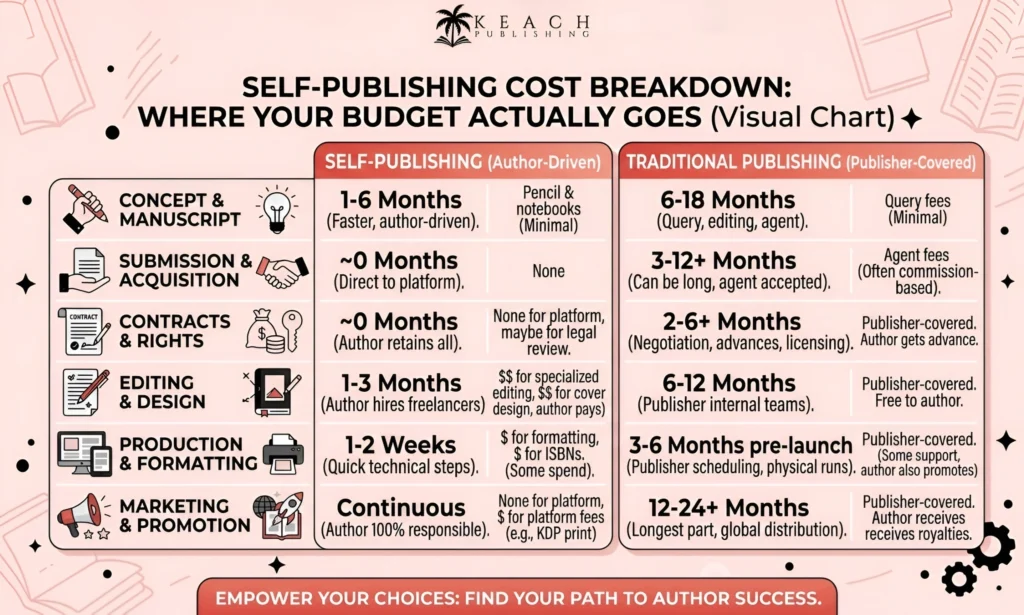
Platform Fees And ISBN Costs
Many authors are surprised to learn that the platforms themselves are largely free to upload to. Amazon KDP, IngramSpark (with some exceptions), and Draft2Digital all take a percentage of each sale rather than charging upfront upload fees. That is good news for your initial budget.
ISBNs are a different matter. In the US, ISBNs are purchased through Bowker. A single ISBN costs $125. A pack of ten costs $295, which is significantly more efficient if you are planning multiple formats or future titles. Platforms like KDP offer free ISBNs, but these come with restrictions: Amazon is listed as your publisher, which limits your ability to distribute through other channels using the same identifier.
For authors serious about professional self publishing, purchasing your own ISBN under your own imprint is the recommended approach. It is a modest cost for a meaningful level of control.
The Full Cost To Publish A Book: What Does It Add Up To?
Here is an honest summary of what the self publishing cost looks like across different budget levels.
| Service | Budget Option | Professional Rate | Notes |
|---|---|---|---|
| Developmental editing | Skip (not advised) | $1,000 to $3,500+ | Critical for structure and clarity |
| Copyediting | $300 to $600 | $600 to $1,500 | Improves grammar, tone, and consistency |
| Proofreading | $150 to $300 | $300 to $700 | Final error check before publishing |
| Cover design | $50 to $150 (template) | $300 to $800 | Professional covers increase conversions |
| Interior formatting | $50 to $100 (DIY tool) | $200 to $500 | Ensures readability across formats |
| ISBN purchase (1 unit) | $125 (Bowker, US) | $125 (Bowker, US) | Required for distribution |
| Marketing and launch | $0 (organic only) | $500 to $3,000+ | Paid promotion boosts visibility |
| Total estimate | $500 to $1,200 | $2,500 to $10,000+ | Depends on quality and strategy |
A few things stand out in that breakdown. First, even the budget path has real costs if you are bringing in any professional help at all. Second, the professional range is wide because it depends heavily on your manuscript’s length, your genre, and how much marketing support you pursue. Third, the categories where budget options exist without serious quality trade-offs (formatting tools, for example) are different from the categories where cutting costs tends to show directly in reader response (editing and cover design).
Keach Publishing offers transparent, author-first book publishing services at every budget level.
Talk to our team and get a custom quote for your book today.What About Book Publishing Services Cost?
Some authors choose to work with a full-service publishing agency rather than sourcing each professional individually. This is a legitimate and increasingly popular route, particularly for first-time authors who would rather not spend months managing a production team while also writing their next project.
Book publishing services cost varies widely depending on the provider and what is included. A package that covers editing, cover design, formatting, and platform setup from a reputable agency might run $2,000 to $6,000. Higher-tier packages that add launch marketing, Amazon ad management, and ongoing distribution support can go higher.
The key question when evaluating any agency is not just the price but what you retain. You should always own your rights, your royalties, and your publishing accounts. Any company that makes those terms unclear or asks you to sign over ownership as part of a publishing package is worth scrutinizing before you commit.
Where To Spend And Where To Save
Not every dollar in publishing has equal impact. Based on what consistently moves the needle for indie authors, here is a practical framework for prioritizing your budget.
Spend on editing. It is the single highest-impact investment you can make. A well-edited book earns better reviews, generates word-of-mouth more reliably, and holds up across the long life of your listing. Spend on cover design. A professional, genre-accurate cover pays for itself many times over in clicks and conversions. Spend on metadata. Not as a direct cost, but as time. The categories and keywords you choose on upload affect your discoverability for as long as your book is live.
Save on interior formatting if you are comfortable with tools like Vellum or Atticus and willing to learn them properly. Save on marketing in the early stages by focusing on organic strategies like ARC readers, author communities, and email list building before moving into paid advertising. Save on platforms, which are largely free to use, by choosing the right distribution setup from the start rather than paying to fix mistakes later.
Conclusion
The cost to publish a book is not one number. It is a set of decisions about where professional quality matters most for your specific book and your specific goals. Authors who invest thoughtfully in the stages that drive reader experience and discoverability consistently produce books that hold their own in competitive markets.
The self publishing cost does not have to be overwhelming. But it does need to be realistic. Going in with a clear budget, an honest assessment of where you need professional support, and a plan that accounts for both production and marketing gives your book a genuinely strong foundation.
At Keach Publishing, we help authors navigate exactly these decisions. Whether you need full-service support or guidance on a specific stage, our team brings real publishing experience to every project. If you are ready to invest in your book the right way, we would love to be part of that process.
Transparent pricing. Professional results. Full author ownership.
Get your free consultation and custom publishing plan today.