
Nobody sits down to write a book thinking about ISBNs and distribution channels. You write because you have something to say, a story to tell, knowledge to share, an experience that deserves to be on the page. But somewhere between typing “The End” and actually getting that book into readers’ hands, a whole other kind of work begins.
The good news? Self-publishing in 2026 is more accessible, more professional, and more author-friendly than it has ever been. The tools are better. The platforms are more transparent. And the stigma that once followed independently published books has largely faded; readers care about whether a book is good, not how it got made.
This beginner’s guide to self publishing a book is for anyone starting from zero. We’ll walk through every major stage of the process, explain what actually matters, and help you understand what to expect before you spend a single dollar or upload a single file.
Not sure where to begin? Book a free strategy call with Keach Publishing, and let’s map out your path.
Why More Authors Are Choosing To Self-Publish
Traditional publishing isn’t going anywhere. But it was never designed for most writers. The average query-to-offer timeline runs anywhere from one to three years, if you’re lucky. Advances for debut authors have remained flat for decades. And once you sign, creative decisions about your cover, title, price, and release date largely leave your hands.
Self-publishing flips that equation. You move on your timeline. You own your cover. You set your price. And perhaps most meaningfully, you earn a significantly higher royalty per sale, typically 35% to 70% depending on the platform and format, compared to the 8% to 15% standard in traditional deals.
That’s not to say self-publishing is easier. It isn’t. You’re taking on real responsibility for production quality and discoverability. But for authors who are willing to approach it seriously, the rewards, creative, financial, and professional, are genuinely compelling.
How To Self-Publish To Book: The Core Stages
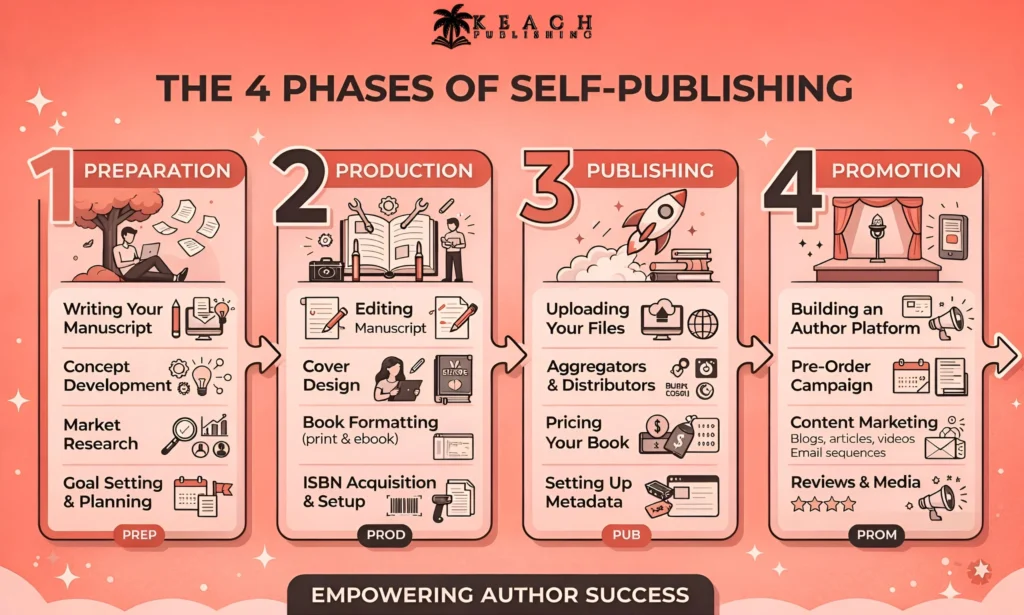
Before diving into the details, it helps to see the process as a whole. Self publishing a book moves through four distinct phases: preparation, production, publishing, and promotion. Each one builds on the last, and rushing any of them tends to create problems that are hard to fix after the fact.
Phase 1: Preparation, The Work Before the Work
Editing is where most beginner authors underinvest, and it’s almost always the biggest factor separating a book that earns five-star reviews from one that quietly stalls. A finished draft is a starting point, not a final product.
At a minimum, plan for two rounds of editing. Developmental editing looks at the big picture, structure, pacing, character arcs (for fiction), or argument flow (for nonfiction). Copyediting addresses sentence-level issues: grammar, consistency, and clarity. Proofreading is the final pass, done after layout is complete, to catch anything that slipped through.
Yes, hiring professional editors costs money. It’s also one of the few investments in publishing where the return is almost always visible in reader response.
Phase 2: Production, Looking Like A Professional
Two things determine whether a reader gives your book a chance: the cover and the formatting. Both need to be professional, genre-appropriate, and polished, especially if you want to compete with traditionally published titles on the same platform.
Your cover should be designed by someone who specializes in books, not general graphic design. Book cover designers understand genre conventions, what fonts signal thriller, what color palettes work for romance, why certain layouts feel “literary,” and others feel “commercial.” These distinctions matter to readers even when they’re not consciously aware of them.
Interior formatting is less glamorous but equally important. Readers may not consciously notice good formatting, but they absolutely notice bad formatting. Inconsistent spacing, awkward chapter breaks, or text that reflows strangely on an e-reader are all signals that erode trust in the reading experience.
Phase 3: Publishing, Getting Your Book Online
This is where you actually publish a book online, the moment your work enters the global distribution network. The main decisions here involve platform selection, metadata, pricing, and whether to pursue wide distribution or go exclusive with one retailer.
Amazon KDP is the most common starting point, and for good reason: Amazon accounts for a substantial majority of ebook sales in the US. But limiting yourself to one platform means leaving potential readers and revenue on the table. IngramSpark opens doors to physical bookstores, libraries, and international markets. Draft2Digital simplifies wide ebook distribution by aggregating across multiple retailers in a single upload.
Your metadata, title, subtitle, categories, keywords, and book description are what connect your book to the right readers. Spend real time on this. A strong, search-optimized book description is doing sales and SEO work simultaneously every single day it’s live.
Which Distribution Route Is Right for You?
| Publishing Route | Best For |
|---|---|
| Amazon KDP only | Authors targeting Kindle Unlimited readers |
| KDP + IngramSpark | Wide print distribution (bookstores, libraries) |
| Draft2Digital | Ebook distribution to multiple retailers at once |
| Direct (your own site) | Authors with an established audience and email list |
| Full-service agency | Authors who want professional support end-to-end |
Phase 4: Promotion, Making Sure People Find It
Uploading your book and waiting is not a marketing strategy. For new authors, especially, visibility doesn’t happen on its own; it gets built.
Before your launch, focus on generating early reviews. Advance Reader Copies (ARCs) sent to beta readers, book bloggers, and newsletter subscribers give you a pool of honest reviews ready to post on launch day. Amazon’s algorithm responds to review velocity, especially early on.
After launch, think about your long-term discoverability. Amazon Ads, running limited-time promotions (like a $0.99 ebook sale), growing your email list, and being genuinely present in your genre’s reading community all contribute. No single tactic does everything; the authors who build real momentum tend to work multiple channels consistently over time.
What A Self-Publishing Guide Won’t Tell You (But We Will)
Most self publishing guides focus on the mechanics. What they often skip is the mindset piece, and that matters too.
Publishing one book and expecting passive income is the fastest path to disappointment. The authors earning meaningful money from indie publishing almost universally have multiple titles. Each new book you add to your catalog extends the reach of everything before it. Book two sells book one. Book five sells books one through four. That’s how the backlist model works, and it’s powerful once it’s in motion.
The other thing worth saying plainly: not every book needs to reach a million readers to be worth publishing. Some authors publish to build credibility in their field. Others publish memoirs they want to leave for their family. Some are building a brand around their expertise. The definition of success is yours to set, just make sure you’ve actually set it before you start, because it shapes every decision that follows.
When It Makes Sense To Work With A Publishing Partner
Going through a self publishing guide step by step is genuinely doable. Plenty of authors handle the entire process themselves, especially once they’ve been through it once or twice. But for many first-time authors, the combination of unfamiliar platforms, technical formatting requirements, metadata optimization, and launch coordination is simply a lot to hold at once.
A professional publishing partner, one who offers real book publishing support, not just a template and a portal, can handle the production and platform side while you focus on the writing and the audience. The key distinction to look for is ownership: any reputable service ensures you retain full rights to your work, your royalties, and your publishing accounts.
At Keach Publishing, that’s exactly how we operate. Our job is to make the technical and logistical side of publishing disappear so you can focus on what you actually came here to do.
Want a publishing partner who handles the hard parts? Connect with Keach Publishing today; your book deserves it.
Final Thoughts
Self-publishing in 2026 rewards authors who take it seriously. That means investing in editing, designing a cover that earns attention, choosing distribution strategically, and building a launch that gives your book a real chance in the market.
The path isn’t without effort. But the creative freedom, the direct reader relationship, and the economics of independent publishing make it a genuinely exciting time to be an author outside the traditional system.
Keach Publishing exists to help authors at every stage of that journey, from the first decision about platforms to the long game of building a career. If you’re ready to move from manuscript to marketplace, we’d love to be part of it.