
Amazon dominates the self-publishing conversation. For good reason, too. The platform offers simplicity, reach, and reasonable royalties. But other players exist. Some offer better distribution. Others provide higher royalties for certain formats.
Choosing the right platform matters. Your decision affects your reach, your earnings, and your creative control. Let me walk you through the major players. You will learn how KDP self publishing compares to the alternatives.
Keach Publishing helps authors evaluate self publishing companies before committing.
Let us help you choose the platform that fits your goals.What Makes Amazon KDP Publishing So Popular?
Amazon KDP publishing attracts millions of authors for several reasons. The platform offers unmatched reach. Amazon controls roughly 80 percent of the ebook market. Your book appears in front of more potential readers here than anywhere else. Ease of use matters too. Uploading a book takes less than an hour. The interface guides you through each step. New authors rarely feel lost or confused.
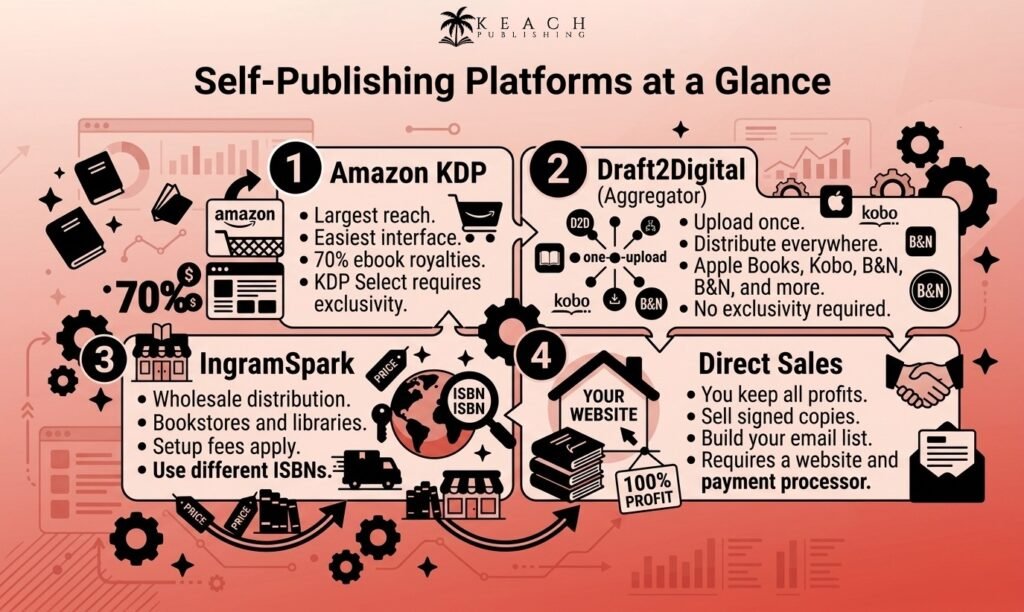
Royalties also attract authors. The 70 percent option for ebooks in certain price ranges beats most competitors. No other platform matches this rate for direct consumer sales. However, exclusivity comes with a cost. KDP Select requires your ebook to appear only on Amazon. You lose access to other retailers like Apple Books and Kobo. Weigh this trade off carefully.
How Do Other Self Publishing Companies Compare?
Draft2Digital acts as an aggregator. You upload once, and they distribute your ebook to multiple retailers. Apple Books, Kobo, Barnes & Noble, and others receive your book automatically. The interface rivals Amazon’s simplicity. Apple Books holds the second largest market share. Apple users tend to spend more per book than Amazon customers. The platform particularly suits romance, literary fiction, and children’s books.
Kobo has a loyal following outside the United States. Canadian readers prefer Kobo. Australian and UK readers also use the platform heavily. Kobo Plus, their subscription service, creates additional earning potential. Barnes & Noble Press offers access to Nook users and the largest bookstore chain in America. Physical placement becomes possible if your book performs well.
If you have been following our series on distribution options, our previous post on Cost to Self-Publish a Book on IngramSpark covers wholesale distribution for bookstores and libraries. IngramSpark serves a different purpose than these retail-focused platforms.
Feeling overwhelmed by all the platform choices?
You are not alone. Keach Publishing provides clear comparisons of top self publishing companies. We help you understand which platform fits your genre, audience, and goals. Let us help you choose wisely so you avoid costly switching later.
What Are the Trade-offs Between Amazon and Wide Distribution?
The central question for most authors is exclusivity versus reach. KDP self publishing with KDP Select means exclusivity. Your ebook appears only on Amazon. In exchange, you access Kindle Unlimited page reads and promotional tools like Countdown Deals. Wide distribution means publishing everywhere. Your ebook appears on Apple Books, Kobo, Barnes & Noble, and Google Play. You lose Amazon’s promotional tools. But you gain access to entirely different reader bases.
Many authors start with Amazon exclusivity. They build momentum using KDP Select tools. Then they leave the program and go wide. This hybrid approach offers the best of both worlds. Test both strategies. Run exclusivity for one book. Go wide with the next. See which generates more income for your specific genre and audience.
Keach Publishing offers guidance on Amazon KDP publishing and wide strategies.
Let us help you test both approaches to find what works for your books.Which Platform Serves Print Books Best?
For print books, Amazon and IngramSpark serve different purposes. Amazon KDP handles direct consumer sales beautifully. Your paperback appears on Amazon’s store. Royalties arrive automatically. Returns rarely happen. IngramSpark serves the wholesale market. Bookstores order your book through Ingram’s catalog. Libraries use Ingram as a primary supplier. Academic institutions rely on Ingram for course materials.
Smart authors use both. Amazon KDP for direct sales. IngramSpark for wholesale distribution. Different ISBNs for each platform. Your book reaches every possible channel. The top self publishing companies for print also include Barnes & Noble Press. Their print quality matches Amazon’s. Physical bookstore placement becomes possible for local authors.
How Do You Choose the Right Platform?
Start with your genre and audience. Romance readers live on Amazon. Literary fiction readers frequent independent bookstores. Nonfiction readers browse libraries. Match your platform to your reader’s habits.
Consider your timeline. Amazon uploads go live in hours. Wide distribution through aggregators takes days or weeks. Plan accordingly.
Think about your long-term goals. Building an email list and direct sales matter more than any platform. Your platform choice should support your broader business strategy, not replace it.
Keach Publishing provides personalized guidance based on your unique book.
Let us help you select the right platform for your goals and your readers.Wrap Up
No single platform works perfectly for every author. Amazon dominates for a reason. Its reach and ease of use are unmatched. Yet other platforms offer advantages. Apple Books reaches different readers. Kobo serves international markets. IngramSpark opens bookstore doors.
The smart approach tests multiple platforms. Start with Amazon. Learn the process. Add wide distribution through an aggregator. Expand to IngramSpark for print. Your platform strategy grows as your career grows.
At Keach Publishing, we help authors navigate every publishing option. From KDP setup to wide distribution to wholesale channels, we handle the technical complexities so you can focus on writing. Your book deserves to reach readers everywhere. Let us help you choose the right path.