

You have finished your manuscript. The cover is beautiful. The formatting is perfect. Now comes the moment that separates successful authors from disappointed ones. Launch day. Many authors think launching means hitting the publish button and hoping for the best. That is not a launch. That is wishful thinking.
A real launch creates momentum. It tells Amazon’s algorithm that your book matters. It puts your book in front of readers who are ready to buy. It sets the stage for weeks and months of ongoing sales. Let me walk you through exactly how to publish a book with a launch that actually works.
Keach Publishing helps authors build book launch strategies that actually move the needle.
Let us help you turn launch day into the start of something big.What Is a Book Launch and Why Does It Matter?
A book launch is the period immediately before and after you publish a book. Usually, the first seven to ten days. This window matters more than almost anything else in your publishing journey. Amazon’s algorithm rewards early sales velocity. A book that sells fifty copies in its first week will rank higher than a book that sells fifty copies over two months.
Higher rankings lead to more visibility. More visibility leads to more sales. This is the launch flywheel. It starts with you. Your early sales create momentum. Momentum creates visibility. Visibility creates organic sales that you did not have to work for.
Without a launch, your book enters the marketplace silently. No one knows it exists. No early sales means no ranking boost. No ranking boost means no visibility. Your book sinks into the catalog, rarely to be seen again. A successful launch is not luck. It is a sequence of deliberate actions taken in the right order. Let me show you that sequence.
When Should You Start Planning Your Launch?
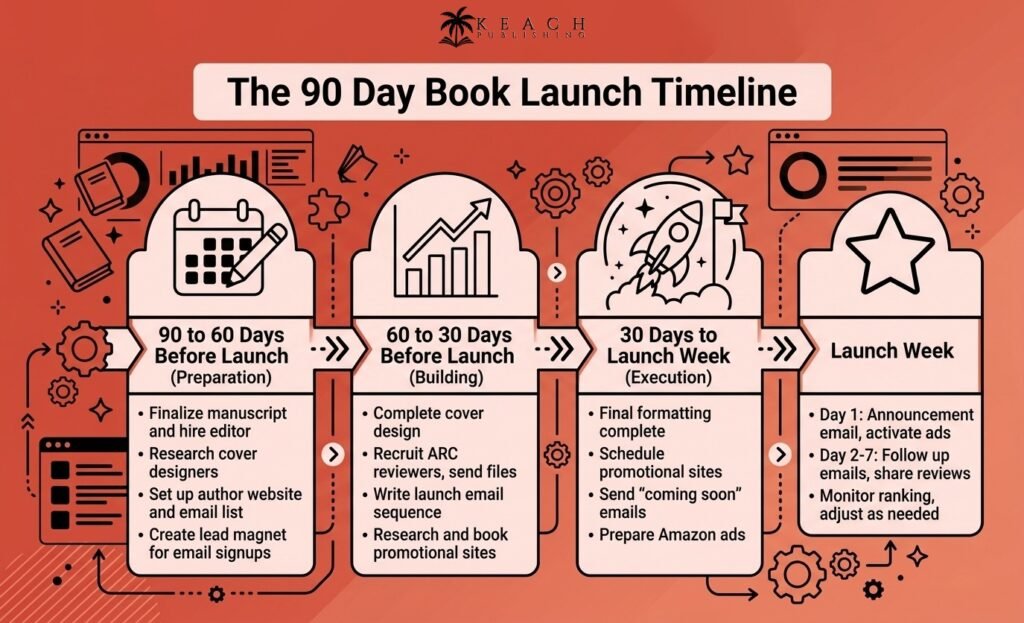
The best time to start your book launch strategy is three to six months before your publication date. Yes, months. This surprises many authors. But building momentum takes time. Three months out, you should be finalizing your manuscript and hiring your editor. You should be researching cover designers. You should be setting up your author website and email list if you have not already.
Two months out, your cover should be in progress. Your email list should be growing. You should be identifying ARC (advanced reader copy) reviewers. You should be researching promotional sites and their submission deadlines. One month out, your cover should be finished. Your formatted files should be ready. Your ARC reviewers should have their copies. Your email sequence should be written. Your promotional sites should be booked.
Launch week itself is about execution. You have done the planning. Now you simply follow your checklist. If you have been following our series on building a sustainable career, our previous post on How to Turn Your Book Into a Business covers the systems and mindset that support a successful launch. Launching is not a one-time event. It is part of a larger business strategy.
Keach Publishing offers book launch marketing guidance that covers every phase.
We help you plan, prepare, and execute a launch that creates real momentum.What Are the Essential Elements of a Book Launch Strategy?
Your email list is your most powerful launch tool after you have publish a book. These are people who have asked to hear from you. They are warm leads. They are likely to buy. Your launch week sales will come primarily from this list. Build it early. Nurture it consistently.
Your ARC team provides your early reviews. Reach out to potential reviewers at least two months before launch. Send them free copies. Ask for honest reviews posted on launch day or shortly after. Five to ten reviews on day one signal quality to Amazon shoppers.
Your promotional sites drive traffic from outside your existing audience. BookBub, Freebooksy, and similar services have large email lists of readers looking for new books. Apply early. These sites book weeks or months in advance.
Your Amazon ads can supplement your launch efforts. Start small. Target your own name and comparable titles. The goal during launch week is visibility and ranking, not immediate profit.
Your social media should be active but not overwhelming. Announce your upcoming release. Share the cover. Build anticipation. But do not spend hours posting when you could be working on other launch tasks.
Book Launch Marketing Channels at a Glance
| Channel | Purpose | When to Activate |
|---|---|---|
| Email List | Core sales, reader notifications | Launch day and throughout the week |
| ARC Reviewers | Early reviews, social proof | Reviews posted on launch day |
| Promotional Sites | New reader discovery | Launch day or within the first week |
| Amazon Ads | Visibility and ranking | Launch week |
| Social Media | Anticipation and announcements | Week before and week of launch |
How Do You Execute Launch Week?
The day before launch, send a “coming soon” email to your list. Remind them that your book will be live tomorrow. Share the cover one more time. Build a little excitement. Launch day arrives. Send the announcement email first thing in the morning. Include direct buy links. Make it easy. Post on social media. Activate your Amazon ads. Check that your promotional sites are running as scheduled. Day two through seven, continue light promotion. Share early reviews.
Thank your ARC reviewers publicly. Send a follow-up email to anyone who has not opened the first one. Run a short ad campaign if your budget allows. Throughout launch week, monitor your ranking. Do not obsess. Check once or twice per day. The goal is to see steady upward movement. Small wins add up. After launch week, the work continues. But you have done the hardest part. You created momentum. Now your job is to maintain it.
What Common Launch Mistakes Should You Avoid?
Even well-intentioned authors make mistakes. Here are the most common ones. Starting too late is the biggest error. If you begin planning your launch two weeks before publication, you have already lost. You need time to build your list, secure ARC reviewers, and book promotions.
No email list means no launch. Without a list of people waiting to buy, your launch sales will come from friends and family only. That is not enough to move Amazon’s algorithm. Build your list before you need it. Forgetting to follow up. One email on launch day is not enough. Send a sequence. A coming soon email. A launch day announcement. A follow-up sharing early reviews. A final reminder before the week ends.
Ignoring Amazon ads. Even a small budget helps. Amazon rewards early sales. Ads can generate those sales while your organic visibility is still low. Not having a post-launch plan. What happens after launch week? Your marketing should continue. Keep emailing. Keep running ads. Keep pursuing reviews. Launch week is the beginning, not the end.
Keach Publishing provides complete book launch support from planning to execution.
Let us help you turn launch day into the start of a successful career.Wrap Up
A successful book launch does not happen by accident. It is the result of careful planning, consistent effort, and the right timing. Start three to six months before your publication date. Build your email list. Secure ARC reviewers. Book your promotions. Then execute your launch week with precision. The authors who succeed are not the ones who got lucky. They are the ones who treated their launch like the important event it is. They planned. They prepared. They executed.
At Keach Publishing, we help authors launch with confidence. From professional formatting to platform setup to launch planning, we handle the technical complexities so you can focus on what matters most. Writing and connecting with readers. Your book deserves a launch that matches its quality. Let us help you make that happen.