

You wrote a book. Maybe it is selling. Maybe it is not. Either way, something feels unstable. You are not sure if you should write another one. You are not sure if this whole author thing is sustainable. Here is the truth that separates hobbyists from professionals.
A single book is a project. A business is something else entirely. A business has systems. A business generates predictable income. A business grows over time. Your book can be the foundation of all of that. The shift from writer to business owner is not about talent. It is about mindset and strategy. Let me show you how to make that shift and turn your book into a real business.
Keach Publishing helps authors build the systems behind successful careers.
Let us help you turn your writing into sustainable income.Why Should You Treat Your Book Like a Business?
Most authors publish one book and hope. Hope is not a strategy. A business does not hope for sales. A business creates systems that generate sales. When you treat your book like a business, everything changes. You stop guessing and start tracking. You stop hoping and start testing. You stop reacting and start planning.
A business mindset means you think in terms of assets. Your backlist is an asset. Your email list is an asset. Your author brand is an asset. Each book you write adds value to the whole system. This mindset protects you, too. When one book has a slow month, your other books keep selling. When one marketing channel slows down, you have others to rely on. A business is resilient. A single book is fragile.
What Does an Author Business Look Like?
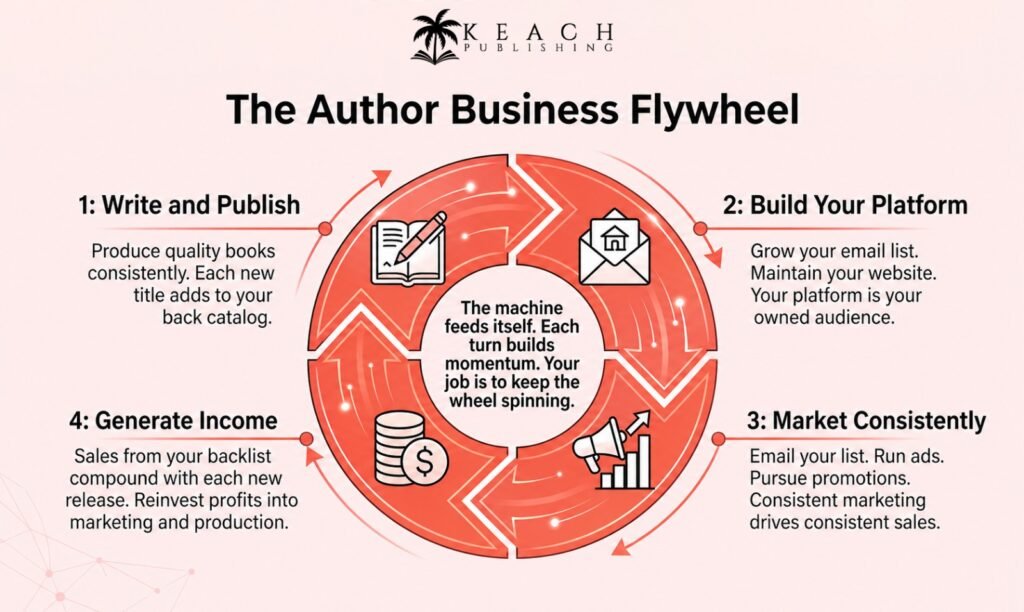
An author’s business has several moving parts. None of them is complicated. Together, they create a machine that generates income. Your books are your products. Each one is something you sell. But here is the key insight. Your books also sell to each other. A reader who loves book one will buy book two. This is why series and backlists are so powerful.
Your amazon kdp account is your primary sales channel. It is the storefront where most of your transactions happen. Optimizing your KDP presence is essential. Titles, keywords, categories, and descriptions all matter. Your email list is your direct line to customers. Social media algorithms change. Amazon’s rules change. Your email list is yours forever. Every subscriber is a person who has invited you into their inbox.
Your website is your home base. It is where new readers go to learn about you. It is where your email signup lives. It is the hub that connects all your other channels. Your marketing efforts are how you attract new customers. Some days you run ads. Some days you send newsletters. Some days you appear on podcasts. Consistent marketing keeps the machine running.
If you have been following our series on expanding your reach, our previous post on How IngramSpark Expands Book Publishing covers the distribution side of your business. Pairing Amazon KDP with IngramSpark creates a complete sales machine.
Keach Publishing offers book marketing and business strategy guidance for authors.
We help you build a complete system, not just a single book.How Do You Build a Business Strategy Around Your Books?
A business strategy sounds intimidating. It does not need to be. It is simply a plan for how you will consistently sell books over time. Start with your production plan. How many books will you publish each year? Once a year is fine. Twice a year is better. The key is consistency. Readers learn to expect your releases.
Next, your pricing strategy. Different books serve different purposes in your business. The first book in a series might be priced low to attract readers. Later books can be priced higher. Nonfiction books often command higher prices than fiction. Your marketing plan is next. Which channels will you use? Email? Ads? Social media? Podcasts? Choose two or three and do them well. Trying to do everything leads to burnout.
Finally, your metrics. What gets measured gets managed. Track your email open rates. Track your ad performance. Track your sales by title and by platform. Use data to make decisions. Here is a simple framework many successful authors use. Publish one book. Build your email list while you write the next one. Launch to your list first. Run ads to find new readers. Repeat.
Book Marketing as an Engine, Not an Event
Book marketing is not something you do only when you have a new release. That is like a restaurant only advertising when they open a new location. You need consistent marketing to keep sales flowing. Email marketing is your anchor. Send a newsletter once or twice a month, even when you do not have a new book. Share behind-the-scenes content. Recommend other books. Ask questions. Stay present in your readers’ lives.
Amazon ads work well for consistent traffic. Set a daily budget. Monitor your results. Scale what works. Cut what does not. Even a small ad budget keeps your books visible. Promotional sites like BookBub can be scheduled throughout the year. A well-timed promotion can boost sales for weeks afterward. Plan these.
Social media is the wild card. It works for some authors and not for others. Test it. If you enjoy it and it drives sales, keep going. If it feels like a chore, focus your energy elsewhere. The key is consistency. Do a little bit every day. A small engine running constantly beats a big engine that only fires up once a year.
Book Marketing Channels at a Glance
| Channel | Best For | Effort Level |
|---|---|---|
| Email Newsletter | Direct sales, reader relationships | Medium |
| Amazon Ads | Consistent traffic, scalable | Medium to High |
| Promotional Sites | Sales spikes, new reader discovery | Low to Medium |
| Social Media | Brand building, engagement | Varies widely |
What Is an Author Platform and Why Do You Need One?
Your author platform is the sum of all the ways readers can find you. Your email list. Your website. Your social media following. Your back catalog. Your reputation. A strong platform means you do not have to rely on luck. When you release a new book, you have people waiting to buy it. When a promotion runs, you have places to announce it. When sales dip, you have levers to pull.
Building a platform takes time. You do not need a million followers. You need a thousand true fans. A thousand people who buy everything you publish. That is enough to build a sustainable career. Start with your email list. Offer a free short story or sample chapter. Put signup forms on your website and in the back of your books. Send regular newsletters. This is the foundation of everything else.
Your website is your home base. Keep it simple. Your name. Your books. Your bio. Your email signup. Nothing fancy is needed. Social media can help, but it is not essential. If you enjoy it, use it. If you hate it, skip it. Your email list is far more valuable than any social media following.
Keach Publishing provides author platform and business strategy guidance for serious authors.
Let us help you build a career that lasts beyond your first book.Wrap Up
Turning your book into a business is not about losing your creative spark. It is about protecting that spark with structure. A business gives you the stability to keep writing. A business turns unpredictable income into something you can rely on.
Start with one book. Add a second. Build your email list. Create a simple website. Market consistently. Track your results. Adjust as you learn. This is not complicated. It just requires consistency.
At Keach Publishing, we help authors build real businesses around their books. From professional formatting to platform setup to marketing guidance, we handle the technical complexities so you can focus on writing. Your book deserves to be more than a one-time project. Let us help you turn it into something sustainable.