

You have published a book. Maybe two. You understand the basics. Upload a manuscript. Add a cover. Hit publish. But something is nagging at you. You know you could be doing more. You sense that the authors who really succeed are playing a different game. You are right.
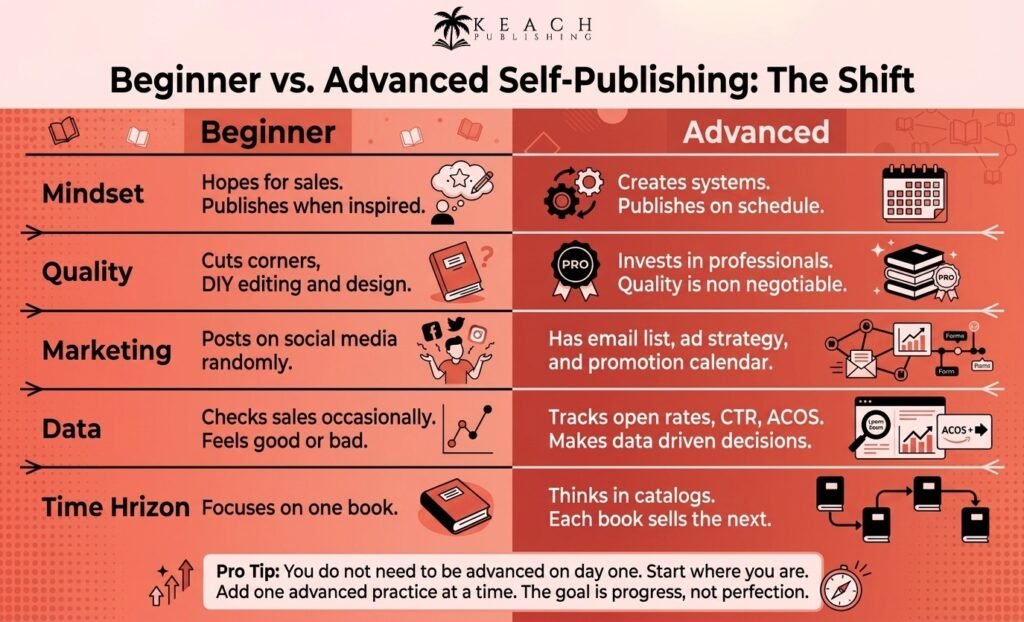
Beginner self-publishing is about getting a book live. Advanced self-publishing is about building a business. It is about systems, data, and long-term thinking. It is about treating your writing career like the professional endeavor it is. The gap between hobbyist and professional is not talent. It is a strategy. Let me walk you through what serious authors do differently.
Keach Publishing helps authors implement advanced self publishing strategies that scale.
Let us help you level up from hobbyist to professional.Thinking Like a Business, Not Just a Writer
The biggest shift in advanced self publishing is mental. You stop thinking of yourself as a writer who happens to sell books. You start thinking of yourself as a business owner who happens to write.
This shift changes everything. A writer hopes for sales. A business owner creates systems to generate sales. A writer publishes when inspiration strikes. A business owner publishes on a schedule. A writer measures success in reviews. A business owner measures success in data.
What does this look like in practice? You set concrete goals. Not “I want to sell more books.” But “I will publish two books this year and grow my email list to 2,000 subscribers.” You track your metrics. Open rates. Click-through rates. Cost per click. Return on ad spend. You make decisions based on data, not feelings.
This does not mean you lose your creative spark. It means you protect it with structure. You create systems so that when it is time to write, you can focus completely on writing.
Professional Book Publishing: The Non-Negotiable Investments
Professional book publishing requires investment. Hobbyists cut corners. Professionals invest in quality because they understand the return.
Professional editing is non-negotiable. Not just a proofread. Developmental editing for structure. Line editing for sentence flow. Copy editing for grammar. Proofreading for typos. Each layer serves a purpose. Skipping any of them shows.
Professional cover design is non-negotiable. Your cover is your first impression. On Amazon, it is a tiny thumbnail. If your cover does not pop at that size, readers scroll past. A professional designer understands genre expectations, typography, and thumbnail readability.
Professional formatting is non-negotiable. Your interior should look clean on every device. No weird spacing. No broken chapter headings. No font issues. Readers notice sloppy formatting. They leave reviews about it.
Professional authors treat these investments not as expenses but as assets. A good cover sells books for years. A well-edited book generates positive reviews that drive more sales. Quality pays for itself.
Author Business Strategy: Building Systems That Scale
Your production system. How do you go from idea to finished manuscript efficiently? Do you outline? Do you write in sprints? Do you have a daily word count goal? The most productive authors do not wait for inspiration. They write on a schedule.
Your quality system. How do you ensure every book meets your standards? Do you have a trusted editor? Beta readers? A proofreader? Professionals have a team. They do not go it alone.
Your launch system. What happens every time you release a book? Do you have a launch checklist? An email sequence? ARC reviewers ready? A repeatable launch system saves time and improves results with every release.
Your marketing system. How do you consistently reach new readers? Do you run ads? Do you have a newsletter schedule? Do you pursue promotional sites? Professionals do not rely on luck. They have systems.
Your audience system. How do you capture email addresses? How often do you email? What do you send? Your email list is your most valuable asset. Treat it like one.
If you want a deeper look at building the audience that makes these systems work, our previous post on Why Every Author Needs a Publishing Strategy covers the foundational planning that supports advanced tactics. Systems and strategy work together.
Keach Publishing offers author business strategy guidance for serious career builders.
We help you build systems that scale with your growing catalog.The Professional Self-Publishing Guide to Data
Track your email metrics. Open rate. Click-through rate. Unsubscribe rate. Which subject lines perform best? Which calls to action get clicks? Use this data to write better emails.
Track your ad metrics. Impressions. Clicks. Cost per click. Conversion rate. Cost per conversion. Return on ad spend. Which keywords convert? Which audiences respond? Scale what works. Cut what does not.
Track your sales data. Which books sell best? Which formats? Which marketplaces? Which times of year? Use this data to inform your publishing schedule and pricing strategy.
Track your reviews. How many reviews does each book have? What is the average rating? What do readers praise? What do they complain about? Use this data to improve your next book. The data does not lie. It tells you what is working and what is not. Professionals listen.
Common Advanced Publishing Mistakes
Publishing too fast. Yes, you need to publish regularly. But quality still matters. A rushed book damages your brand. Find the balance between speed and quality.
Ignoring your backlist. Your older books are still for sale. Run ads for book one in a series. Link to your backlist in your new releases. Your backlist is free money.
Going wide too early. Wide distribution sounds good. But Amazon is where most readers are. Build momentum on Amazon first. Then expand.
Not testing ads. Running the same ads forever without testing is wasteful. Run experiments. Change one variable at a time. Scale what works. Kill what does not.
Keach Publishing provides professional self publishing guidance for serious authors.
Let us help you build systems, track data, and scale your career.Wrap Up
Advanced self-publishing is not about secrets or hacks. It is about professionalism. Systems over wishes. Data over feelings. Quality over shortcuts. Long-term thinking over quick wins.
The gap between hobbyist and professional is not talent. It is intentionality. It is the decision to treat your writing career like a business. To invest in quality. To build systems. To track data. To keep showing up, book after book.
At Keach Publishing, we help serious authors build serious careers. From professional formatting to platform setup to author websites to business strategy, we handle the technical complexities so you can focus on what you do best. Writing. You have moved beyond beginner. Now it is time to publish like a professional.